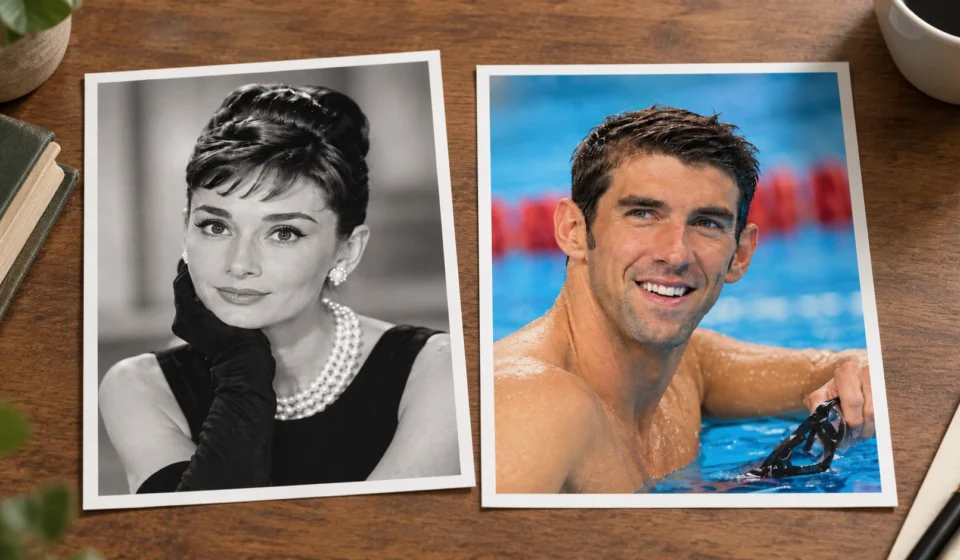

Michael Phelps and Audrey Hepburn do not have a documented family, professional, or notable personal relationship. No credible public record establishes that they collaborated, and no documented meeting between them has been identified. Their lives did overlap briefly, but only while Phelps was a child: Hepburn died on January 20, 1993, when he was seven years old.
That age matters because some recent pages incorrectly say Phelps was eight when Hepburn died. His verified birth date is June 30, 1985, according to the U.S. Olympic & Paralympic Museum. His public sporting career came considerably later: he made his Olympic debut at Sydney in 2000 at age 15.
The two names therefore make more sense as separate biographies than as a hidden relationship story. Hepburn became an Academy Award-winning actress and later a UNICEF Goodwill Ambassador. Phelps became the most decorated Olympic swimmer of his era, winning 28 Olympic medals across five Games before turning more of his public attention to water safety, mental wellness, and youth programs.
Need to know
- No documented family relationship, professional collaboration, or notable personal relationship between Michael Phelps and Audrey Hepburn has been established.
- No credible public record of a meeting has been identified, but that is not the same as proving that they never crossed paths in any private or incidental circumstance.
- Phelps was seven, not eight, when Hepburn died in January 1993.
- Phelps won 28 Olympic medals, including 23 gold, across five Olympic Games.
- Hepburn served as a UNICEF Goodwill Ambassador from 1988 until her death in 1993.
Are Michael Phelps and Audrey Hepburn actually connected?
The most accurate answer is that no meaningful documented connection between them has been established.
There is no verified family relationship tying the Phelps and Hepburn families together. There is no known film, sporting event, charity campaign, advertising project, interview, or other professional collaboration involving both figures. There is also no credible record of a notable meeting.
That last point requires careful wording. Hepburn was still alive for the first seven years of Phelps’s life, so the dates alone cannot prove that an incidental encounter was impossible. What the chronology does show is that they were never public contemporaries in their defining careers. Hepburn’s major film achievements were decades old before Phelps reached the international sporting stage, and she died seven years before his Olympic debut.
Claims that the two “never met” go further than the available evidence supports. The defensible conclusion is narrower: no documented meeting or relationship has been established.
The timeline explains why the pairing is unusual
Audrey Hepburn was born on May 4, 1929, in Brussels, Belgium. By the early 1950s, she had moved from ballet and stage work into film and was on the verge of international fame.
Michael Phelps was born much later, on June 30, 1985, in Baltimore, Maryland. Hepburn had already spent decades as an internationally recognized actress by that point and was approaching the humanitarian phase that defined the final years of her public life.
In 1988, when Phelps was three, Hepburn became a UNICEF Goodwill Ambassador. UNICEF records her service in that role from 1988 to 1993 and identifies Ethiopia in 1988 as her first official mission. The UNICEF profile of Audrey Hepburn also preserves her own explanation of why humanitarian relief carried personal meaning for her: she recalled having received food and medical assistance after World War II.
Hepburn died at her home in Switzerland on January 20, 1993. Phelps’s eighth birthday would not arrive until June 30 of that year.
His Olympic career began in Sydney in 2000.
Michael Phelps: from teenage Olympian to record-setting swimmer
Phelps arrived on the Olympic stage unusually young. At 15, he competed for the United States at the 2000 Sydney Games. He did not win a medal there, but the appearance began a five-Olympics career stretching through Athens 2004, Beijing 2008, London 2012, and Rio 2016.
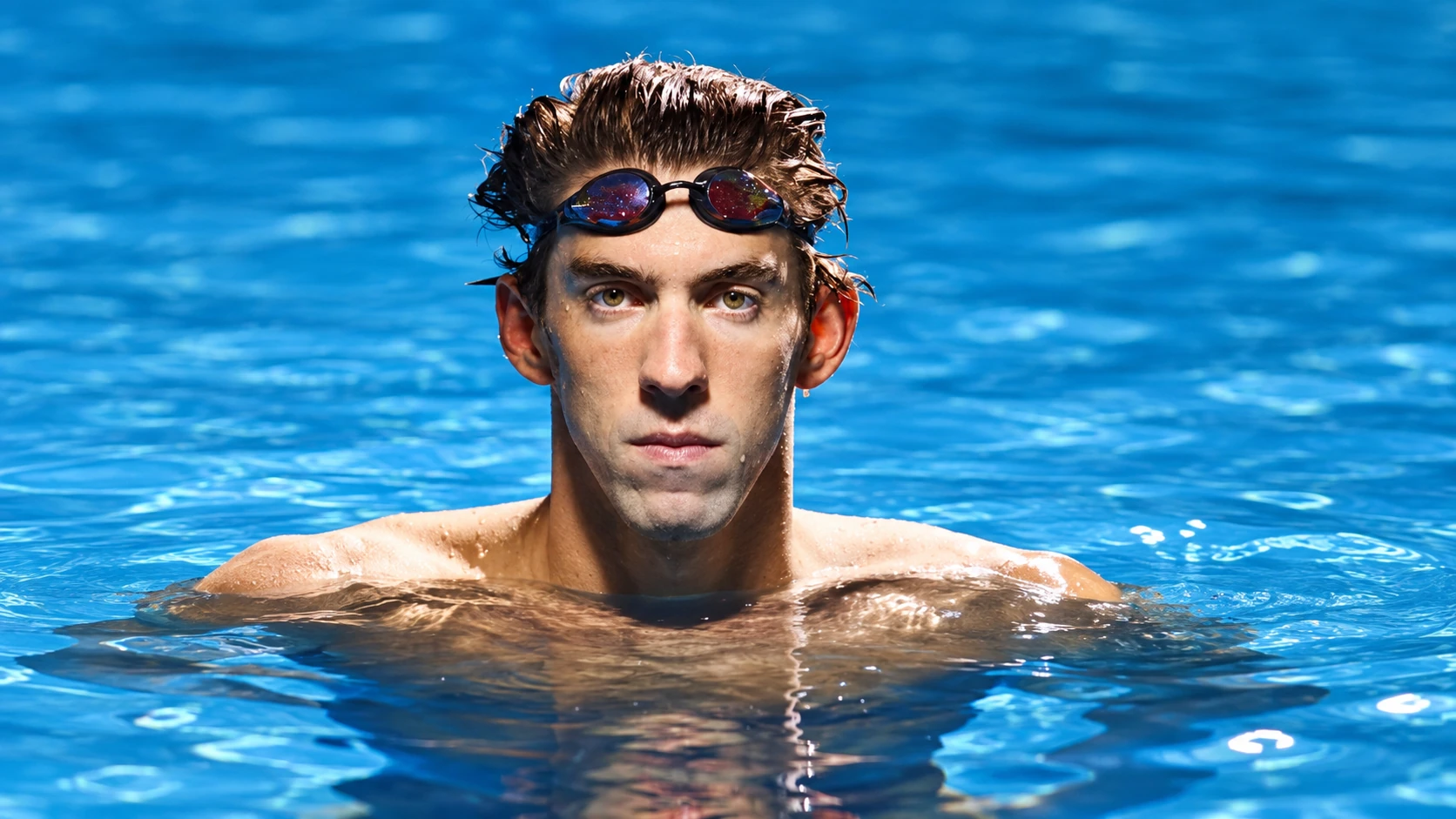
The scale of what followed is best understood through the official medal record. World Aquatics lists 28 Olympic medals: 23 gold, three silver, and two bronze.
Athens marked his first major Olympic medal haul. In 2004, Phelps won six gold medals and two bronze medals.
Beijing in 2008 became the defining competitive performance of his career. He entered eight events and won gold in all eight, giving him one of the most recognizable single-Games achievements in Olympic history. His success came across individual races and relays rather than through specialization in only one event.
Phelps continued competing after Beijing rather than ending his Olympic career at its most obvious high point. He added medals at London in 2012 and returned once more for Rio in 2016, his fifth and final Olympics.
His route through elite swimming also included several years connected with the University of Michigan. The university has said that he trained, coached, and attended classes there for four years beginning in 2004. That wording is important: it documents his Michigan affiliation without establishing that he earned a university degree.
What Phelps does after Olympic competition
Phelps’s public identity did not end with his final race.
The Michael Phelps Foundation says it was founded in 2008, the same year as his eight-gold performance in Beijing. Its work now includes water safety, mental wellness, healthy living, confidence, and youth programming.
As of September 2026, the Foundation’s team page lists Phelps as Founder.
His post-competition work has also included public discussion of mental wellness. In an interview hosted by Special Olympics, Phelps described his priorities in terms that moved beyond medals: “I want to change a life, and if I can save a life…” That statement provides a clearer picture of his later public focus than attempting to infer what retirement meant to him privately.
The progression is straightforward: competitive swimming made Phelps internationally famous; his later work has increasingly used that visibility for water-safety and wellness programs.
Audrey Hepburn: ballet, Broadway, and Roman Holiday
Hepburn’s public life followed a completely different route.
UNICEF’s official biography records that she studied ballet before moving into stage and film work. An important turning point came when the French writer Colette selected her to play the title role in the Broadway production of Gigi.
Her major film breakthrough followed with Roman Holiday. Playing Princess Ann opposite Gregory Peck, Hepburn became an international star and won the Academy Award for Best Actress. The Academy’s 1954 ceremony record confirms her win for the 1953 film.
Her recognition was not limited to film. In 1954, she also won a Tony Award for Actress in a Play for Ondine.
Hepburn would go on to appear in films including Sabrina, Funny Face, Breakfast at Tiffany’s, Charade, and My Fair Lady. A full filmography is unnecessary to understand her significance: Roman Holiday established her as an award-winning leading actress, while later films sustained the screen image that made her one of the most recognizable performers of her generation.
Humanitarian work became a major part of Hepburn’s later life
Hepburn’s public career changed substantially in its later years.

She became a UNICEF Goodwill Ambassador in 1988 and undertook missions on the organization’s behalf. UNICEF identifies her 1988 Ethiopia trip as her first official mission. Her work thereafter included public advocacy for children affected by hunger, conflict, poverty, and inadequate access to essential services.
The connection was not merely symbolic in Hepburn’s own telling. She said that she could testify to UNICEF’s importance because she had herself received food and medical relief after World War II.
Her humanitarian work brought major recognition near the end of her life. In December 1992, she was among the recipients of the Presidential Medal of Freedom. In January 1993, the Academy’s Board voted to give her the Jean Hersholt Humanitarian Award. She died eight days later, and her son Sean Hepburn Ferrer subsequently accepted that award on her behalf.
That humanitarian record remains part of Hepburn’s public relevance decades later. UNICEF’s 2026 anniversary materials still feature archival documentation of her 1988 Ethiopia mission and her 1989 appearance connected with the Convention on the Rights of the Child.
Why the two names can be misleading when placed together
Michael Phelps and Audrey Hepburn are easy to compare at a very broad level: both achieved international fame, and both later became associated with public causes beyond the work that first made them famous.
But those similarities should not be mistaken for evidence of a relationship between them.
Hepburn’s humanitarian work belonged to UNICEF and the final years of a career rooted in film and theatre. Phelps’s later public work developed from a career in elite swimming and through his own foundation. There is no verified evidence that Hepburn influenced Phelps directly, that Phelps publicly cited Hepburn as an inspiration, or that they were involved in the same charitable project.
The distinction is useful because online comparison can create the appearance of a historical connection simply by placing two famous names beside one another. In this case, the verified biographies remain separate.
A few common claims that need correcting
One recurring error is that Phelps was eight when Hepburn died. The verified dates make the correction simple: he was born June 30, 1985, and she died January 20, 1993. He was seven.
Another inaccurate claim gives 1989 as the start of Hepburn’s UNICEF ambassadorship. UNICEF’s own records place the beginning in 1988, the year of her first official mission to Ethiopia.
It is also misleading to describe Hepburn as “British-born.” Whatever nationality questions may arise elsewhere in her biography, her birthplace itself is not in dispute: she was born in Brussels, Belgium.
The larger misconception is the idea that a search pairing must represent a real relationship. For Phelps and Hepburn, the public record does not support that assumption.
Conclusion
Michael Phelps and Audrey Hepburn became internationally known through very different kinds of achievement. Hepburn’s public life moved from ballet and stage work into an Oscar-winning film career and, later, substantial humanitarian service with UNICEF. Phelps’s career developed through competitive swimming, from a teenage Olympic debut to 28 medals across five Games, followed by foundation work centered on water safety and wellness.
What links their names in current searches is less certain than what separates their documented lives. No established family relationship, collaboration, or notable meeting has been verified. The clearest answer is therefore also the simplest: they are two major public figures from different generations whose biographies sometimes appear together, but whose historical records do not establish a meaningful personal connection.
tsnews.co.uk